
CELPIP · IELTS · November 10, 2026
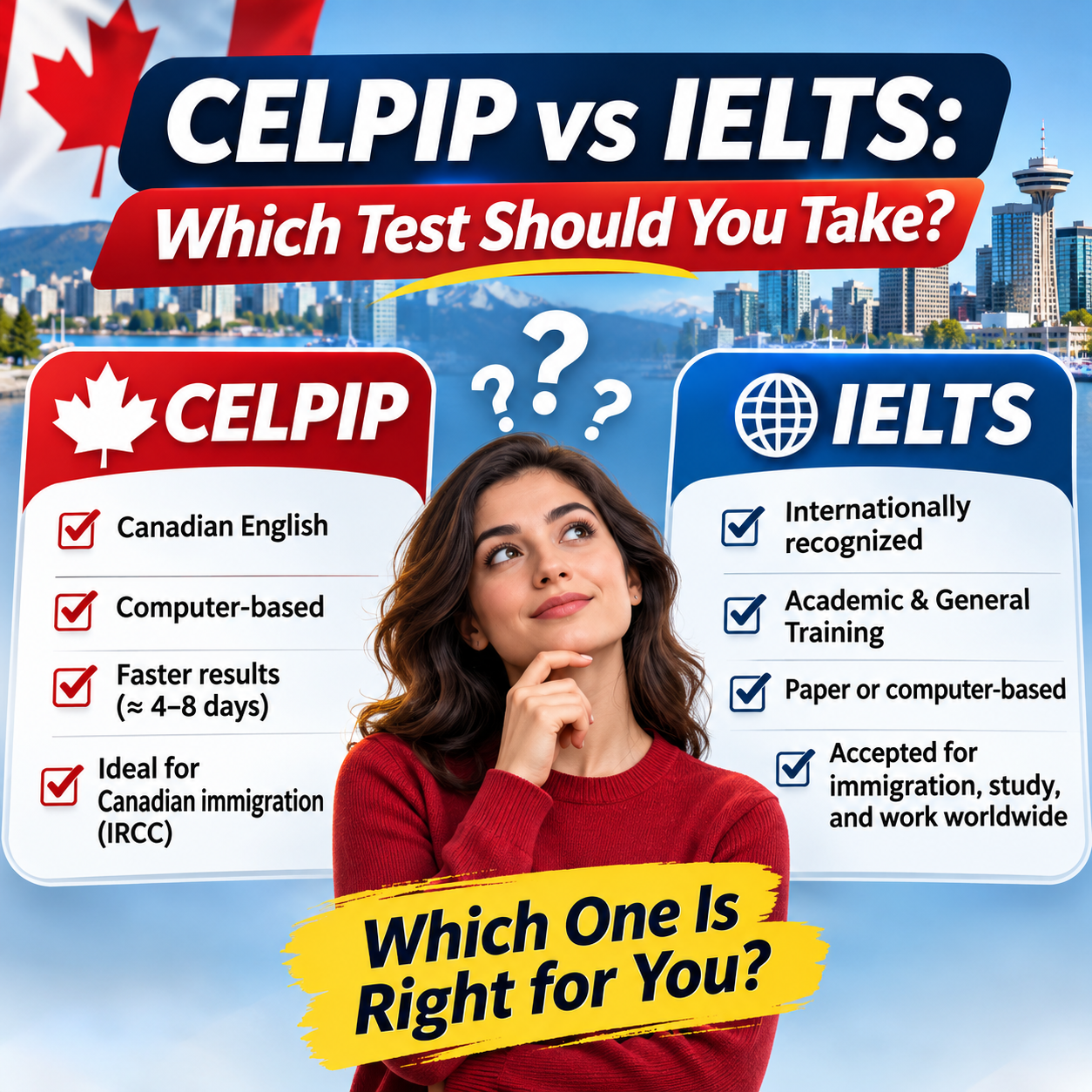
CELPIP vs IELTS: Which Test Should You Take?
CELPIP and IELTS General Training compared: format, speaking, scoring, CLB equivalencies, and how to choose the right test for Canadian immigration.
By Amir Abbas Ravaei, PhD in TESOL, Founder and CEO, Vancouver TESOL Training Center (VTTC)
If you are applying for Canadian permanent residence, one of your first decisions is which English test to take. For most applicants, the choice comes down to two tests: CELPIP-General and IELTS General Training.
Both are accepted by Immigration, Refugees and Citizenship Canada (IRCC). Both assess Listening, Reading, Writing and Speaking. Both results are converted into Canadian Language Benchmark (CLB) levels. Yet the two tests feel very different on test day, and many candidates find that one suits them noticeably better than the other.
There is no single "easier" test. There is, however, a test that is likely to be better for you, depending on your skills, your habits and your goals. This guide compares CELPIP and IELTS side by side and gives you a practical way to decide.
The Short Answer
- If your goal is Canadian immigration or citizenship only, both tests meet IRCC's requirements. Choose the one whose format plays to your strengths.
- If you are comfortable with computers and typing, and prefer everyday North American contexts, CELPIP is often a natural fit.
- If you prefer speaking to a real person, or you may also need your results for another country, IELTS General Training may suit you better.
- If you are unsure, try a practice test in each format. Your scores and your comfort level will usually make the decision clear.
First, Make Sure You Choose the Right Version
Both tests have more than one version, and choosing the wrong one is a costly mistake.
- CELPIP: For permanent residence, you need the CELPIP-General Test. For citizenship, IRCC accepts CELPIP-General or CELPIP-General LS, which tests only Listening and Speaking.
- IELTS: For Express Entry, you must take IELTS General Training. IELTS Academic is a different test, designed mainly for university admission.
- IELTS One Skill Retake: IRCC does not accept the IELTS One Skill Retake for Express Entry. You need results from one complete sitting.
CELPIP vs IELTS at a Glance
| CELPIP-General | IELTS General Training | |
|---|---|---|
| Accepted by IRCC for Express Entry | Yes | Yes |
| How the test is delivered | Entirely on computer, in one sitting | On computer or on paper at a test centre |
| Speaking test | Recorded on computer; you respond to on-screen prompts | Face-to-face conversation with an examiner (or a video-call examiner at a test centre) |
| When Speaking takes place | Same sitting as the other components | Same day, or up to about a week before or after, depending on the test centre |
| Content and contexts | Everyday situations in Canadian community and workplace contexts | General and workplace contexts, with a range of English accents in Listening |
| Score scale | CELPIP levels, one score per skill (up to 12) | Band scores from 0 to 9 in half-band steps, plus an overall band |
| Conversion to CLB | One to one: CELPIP 7 = CLB 7 | Different band requirements for each skill |
| Approximate test length | About 3 hours | About 2 hours 45 minutes |
| Results | Usually within a few business days | Computer: usually within 1–5 days; paper: up to 13 days |
How the Tests Differ, Component by Component
Listening
| CELPIP | IELTS General Training | |
|---|---|---|
| Structure | 6 parts, 38 scored questions | 4 parts, 40 questions |
| Time | About 46–55 minutes | About 30 minutes |
| Content | Problem solving, daily-life conversations, information, news, discussions, viewpoints | Everyday social situations, then increasingly academic and training-related contexts |
| Answer format | Multiple choice on screen | A mix of formats, including completion tasks where you write the answer |
What this means for you: In IELTS completion tasks, you write words you hear, and spelling matters. CELPIP Listening uses multiple-choice questions, so spelling is not part of the answer. On the other hand, CELPIP Listening is longer and includes extended discussions and viewpoints, which demand sustained concentration.
Reading
| CELPIP | IELTS General Training | |
|---|---|---|
| Structure | 4 parts, 38 scored questions | 3 sections, 40 questions |
| Time | About 43–56 minutes | 60 minutes |
| Texts | Correspondence, a diagram, information texts, viewpoint texts | Short everyday texts, work-related texts, and a longer general-interest text |
| Answer format | Multiple choice | A variety of formats, including completion tasks, matching and True/False/Not Given |
What this means for you: Candidates who find IELTS question types such as True/False/Not Given difficult often prefer CELPIP's format. Candidates who read quickly and handle varied question types well may be comfortable with either.
Writing
| CELPIP | IELTS General Training | |
|---|---|---|
| Tasks | Task 1: an email; Task 2: a response to survey questions | Task 1: a letter (at least 150 words); Task 2: an essay (at least 250 words) |
| Time | 53 minutes | 60 minutes |
| How you write | Typed on computer | Typed on computer, or handwritten on the paper-based test |
| How it is assessed | Content/Coherence, Vocabulary, Readability, Task Fulfillment | Task achievement or response, coherence and cohesion, lexical resource, grammatical range and accuracy |
What this means for you: CELPIP's survey task asks you to choose an option and argue for it, which many candidates find more practical than an IELTS essay. IELTS Task 2 is worth twice as much as Task 1, so the essay carries most of the Writing score. If you type slowly, practise typing under time pressure before choosing CELPIP; if you are taking IELTS on paper, practise handwriting legibly within the time.
Speaking
| CELPIP | IELTS General Training | |
|---|---|---|
| Format | 8 tasks, each answered into a microphone after a short preparation time | A three-part conversation with an examiner |
| Time | About 15 minutes | 11–14 minutes |
| What it feels like | Structured, timed responses to on-screen prompts | An interactive conversation, with follow-up questions |
What this means for you: This is often the deciding factor. Some candidates feel nervous speaking to an examiner and prefer the predictability of recording their answers. Others find it unnatural to speak to a computer and perform better in a real conversation, where an examiner's questions help them develop their ideas. Think honestly about which situation brings out your best English.
The Score Comparison That Matters Most
Because IRCC converts both tests into CLB levels, the most useful comparison is what each test requires for each CLB level. The table below uses IRCC's official equivalency charts.
| CLB level | CELPIP (each skill) | IELTS Listening | IELTS Reading | IELTS Writing | IELTS Speaking |
|---|---|---|---|---|---|
| CLB 10 | 10 | 8.5 | 8.0 | 7.5 | 7.5 |
| CLB 9 | 9 | 8.0 | 7.0 | 7.0 | 7.0 |
| CLB 8 | 8 | 7.5 | 6.5 | 6.5 | 6.5 |
| CLB 7 | 7 | 6.0 | 6.0 | 6.0 | 6.0 |
| CLB 6 | 6 | 5.5 | 5.0 | 5.5 | 5.5 |
| CLB 5 | 5 | 5.0 | 4.0 | 5.0 | 5.0 |
| CLB 4 | 4 | 4.5 | 3.5 | 4.0 | 4.0 |
Two observations are worth noting.
CELPIP is simpler to read. Your CELPIP level is your CLB level. With IELTS, you need to check each skill against the chart, because the bands required differ by skill.
IELTS Listening has a high bar at the top levels. For CLB 9, IELTS requires 8.0 in Listening but 7.0 in the other three skills. For CLB 10, Listening requires 8.5. Candidates targeting CLB 9 or 10 through IELTS should pay particular attention to Listening.
This does not mean either test is easier. The tests are different, and the equivalencies reflect how each one measures ability. What it does mean is that you should compare your practice results in each test against the table, skill by skill.
Which Requirement Are You Aiming For?
The same CLB requirements apply whichever test you take:
| Application | Minimum requirement (English) |
|---|---|
| Federal Skilled Worker Program | CLB 7 in all four abilities |
| Canadian Experience Class | CLB 7 for TEER 0 or 1 experience; CLB 5 for TEER 2 or 3 experience |
| Federal Skilled Trades Program | CLB 5 in speaking and listening; CLB 4 in reading and writing |
| Canadian citizenship | CLB 4 in speaking and listening |
These are minimums for eligibility. In Express Entry, higher CLB levels earn more points in the Comprehensive Ranking System, which is why many candidates aim for CLB 9 or above. For Express Entry, results must be less than two years old when you create your profile and when you apply for permanent residence. Always confirm current requirements on the official IRCC website.
How to Decide: A Practical Checklist
| Consider CELPIP if... | Consider IELTS General Training if... |
|---|---|
| You are comfortable typing and working on a computer | You prefer handwriting, or want the option of a paper-based test |
| You would rather record your speaking than talk to an examiner | You perform better in a real conversation with follow-up questions |
| You find multiple-choice formats easier than writing answers | You are comfortable with completion tasks and accurate spelling |
| You prefer everyday Canadian contexts | You are used to a range of English accents and contexts |
| You want a straightforward CELPIP-to-CLB conversion | You may also need your results for study or immigration outside Canada |
| You want to complete the whole test in one sitting | You are fine with Speaking on a different day from the other components |
Other factors to check
- Test availability: Check test dates and centres near you. Availability differs by location, and IELTS is offered in more countries.
- Your timeline: Both tests release results within days for computer-based testing. Paper-based IELTS takes longer.
- Cost: Fees vary by test and location. Check the current fee on the official website of each test.
- Your future plans: If you might later need English results for another country or for university admission, consider whether one test serves more of your goals.
Our Recommendation: Let Your Practice Results Decide
At VTTC, we advise candidates not to choose a test based on reputation or on what worked for a friend. The better approach is evidence-based:
- Take a timed practice test in each format, ideally a full test or at least one section of each skill.
- Convert both results to CLB levels using the table above, skill by skill.
- Compare your lowest skill in each test. For most immigration requirements, your weakest skill decides whether you meet the minimum.
- Consider your comfort level, especially in Speaking and Writing, and how much preparation each test would need.
- Commit to one test and prepare specifically for its format, question types and scoring criteria.
Switching between tests repeatedly is usually inefficient. Strategies, timing and task types differ enough that focused preparation for one test produces better results than general preparation for both.
Common Myths About CELPIP and IELTS
"CELPIP is easier than IELTS." Neither test is simply easier. Many candidates do find one format more comfortable, and that difference can affect their results, but which test suits you depends on your skills.
"IELTS Academic is a higher-level test, so it must be accepted." IELTS Academic is not the test IRCC requires for Express Entry. You need IELTS General Training.
"I can combine my best skills from different test dates." For Express Entry, you need results from one complete test. IRCC does not accept the IELTS One Skill Retake for Express Entry.
"A CELPIP 9 and an IELTS 9 are the same." They are not. CELPIP 9 equals CLB 9. IELTS band 9 is the top of the IELTS scale, and the band required for CLB 9 differs by skill.
"Native-like fluency guarantees a high score in either test." Both tests reward familiarity with the format, timing and task requirements. Fluent speakers still lose points through unfamiliarity with the test.
How VTTC Can Help
Vancouver TESOL Training Center prepares candidates for both tests, so we can help you choose objectively and then prepare effectively.
- CELPIP Preparation Course: expert strategies, full-length mock tests and professional feedback, online or in person.
- IELTS Preparation Course: preparation for General Training and Academic candidates, with full-length mock tests, sectional practice and detailed feedback.
- CELPIP Practice Tests & Mock Exams: 48 sectional practice tests and 10 comprehensive mock exams.
- Practice and mock test packages for CELPIP, IELTS and other English tests.
Not sure which test is right for you? Book a free consultation, and we will help you compare your options based on your goals and current level.
Frequently Asked Questions
Does IRCC prefer CELPIP or IELTS?
No. IRCC accepts both CELPIP-General and IELTS General Training for Express Entry and converts both to CLB levels. Your CLB levels are what count, not which test you took.
Is CELPIP only for Canada?
CELPIP is designed for Canadian immigration, citizenship and professional purposes. If you need English results for another country, IELTS is accepted more widely, but check the requirements of the specific organization.
Can I take CELPIP if I live outside Canada?
CELPIP is available in a number of locations outside Canada, but fewer than IELTS. Check the official CELPIP website for current test locations.
Which test is better for CLB 9?
It depends on your skill profile. Compare your practice results in each test with the official CLB equivalencies. Note that IELTS requires 8.0 in Listening for CLB 9, while the other three skills require 7.0.
Can I use IELTS Academic for permanent residence?
No. For Express Entry, IRCC requires IELTS General Training.
Which test should I take for citizenship?
IRCC accepts CELPIP-General, CELPIP-General LS and IELTS General Training, among other proof. You need CLB 4 in speaking and listening. CELPIP-General LS tests only Listening and Speaking, the two skills required.
How long are the results valid?
For Express Entry, your results must be less than two years old when you create your profile and when you submit your application for permanent residence.
Conclusion
CELPIP and IELTS General Training both open the door to Canadian immigration. Neither is simply easier. The best test for you is the one whose format suits your strengths, measured honestly against the CLB levels you need.
Start with evidence: try both formats, compare your results skill by skill, choose one test, and then prepare specifically for it. That approach saves time, money and stress, and gives you the best chance of reaching your target score.
Get expert advice on choosing your test
Contact Vancouver TESOL Training Center for guidance on CELPIP and IELTS preparation, practice tests and mock exams.
Vancouver TESOL Training Center
Unit 100 - 132 East 14th Street
North Vancouver, BC V7L 2N3
CanadaWebsite: www.vttcenter.ca
Email: info@vttcenter.ca
Phone: 604-518-5748
Sources
- Government of Canada, Language test equivalency charts
- Government of Canada, Express Entry: Language test results
- Government of Canada, Language proof for citizenship
- CELPIP, CELPIP-General Overview Study Pack 2026
- CELPIP, Viewing Your Test Results
- IELTS Canada, Test Format
- IDP IELTS Canada, IELTS for Canadian immigration